
What Happens After Rehab Ends? Inside the Model Changing Brain Injury Recovery
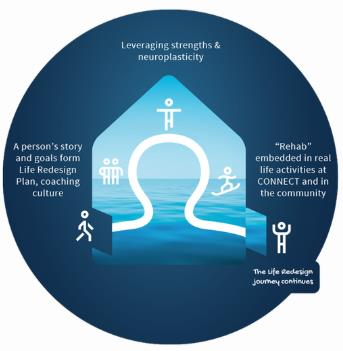
The Life Redesign Model — a continuous, person-centered journey from assessment to independent living in the community.
What is the Life Redesign Model? A New Approach to Brain Injury Recovery
After a brain injury, the traditional path looks like this: acute care, inpatient rehab, discharge — and then a gap. A gap where many people end up in long-term care facilities, or at home without the specialized support they need to keep progressing. The system treats the injury, stabilizes the person, and then often has no meaningful rehabilitation program to send them to next. An estimated 20–30 percent of people are hospitalized in nursing homes or long-term care. For many, that becomes permanent. CONNECT Communities was founded in 1993 by mother-son team Janet and John Sherwood to fill that gap. And over the past 30 years, the organization has developed something that is changing what recovery looks like for people living with brain injury and stroke. It is called the Life Redesign Model.
Rehab that lives where you live
The Life Redesign Model starts with a simple idea — the best rehabilitation does not happen in a clinical setting. It happens in real life. Traditional rehab pulls people out of their daily routines and places them in therapy rooms to practice isolated skills. The Life Redesign Model does the opposite. It embeds rehabilitation into everyday activities. Cooking a meal, going grocery shopping, planning an outing, managing a household. These are not distractions from rehab. They are rehab. This approach is grounded in neuroplasticity — the brain's ability to rewire itself and form new neural connections after injury. Research shows that neuroplasticity is driven by meaningful, repeated activity in real environments. The complexity, novelty, and emotional engagement of real-life situations activate the brain in ways that clinical exercises alone cannot. CONNECT's custom Life Redesign Plan leverages neuroplasticity by pursuing individual goals in real life, non-institutional settings at the right time, with the right approach, and in the right environment to get the best results. CONNECT approaches Life Redesign holistically so that all aspects of health are addressed, including a person's physical, functional, psychological, cognitive, emotional, behavioral, social, and cultural health. The goal is not just to rehabilitate. It is to help someone redesign their entire life around who they are now and who they want to become.
Coaches, not caregivers
At CONNECT, staff are not called caregivers or therapists. They are called coaches. Every role in the organization is built around a coaching philosophy that embodies "doing with" rather than "doing for". Occupational Therapists are Independence Coaches. Physiotherapists are Physical Coaches. Recreation Therapists are Play Coaches. Nurses are Health and Wellness Coaches. Speech-Language Pathologists are Communication Coaches. Social Workers are Social Wellness Coaches. And the people working directly in the homes every day are Life Redesign Coaches. This is not just a naming choice. It reflects a fundamental shift in how support is delivered. Coaches work alongside the people they support, empowering them to take ownership of their own recovery and build a day based on their preferences. CONNECT hires for personality and values, not just qualifications, because the culture of home matters just as much as the clinical expertise inside it.
Homes, not institutions
CONNECT's environments are designed to feel exactly what they are — a home. There is no central housekeeping, no catering, or institutional amenities. Everyone in the building does what they can, and the coaching team supports them to make it all happen. The homes blend naturally into their neighborhoods, allowing for easy interaction and integration with the community around them. This matters because recovery does not happen in isolation. It happens through relationships, routines, community participation, and the kind of accountability that comes from running your own life. CONNECT's culture is built on personal accountability, supported risk-taking, social capital, and meaningful community participation. The model says "yes" first and offers opportunities for individuals to return to living in the community.
The numbers behind the model
CONNECT recently completed a comprehensive Value Proposition based on data from its Hamilton, Ontario location, in partnership with Hamilton Health Sciences. The results exceeded expectations. Between September 2019 and December 2023, 98 people transitioned out of CONNECT Hamilton. In the traditional system, an estimated 20–30% of people with moderate to severe brain injuries end up in long-term care. At CONNECT Hamilton, that number was just 7.1%, and 70.4% (69 out of 98 individuals) are now living at home with either support from families or living independently. To put that in perspective, 57.5% of individuals who move into CONNECT Hamilton arrive with severe functional limitations. These are people the traditional system has already done everything it can for. And yet 70% of them move home. Clinically, CONNECT has achieved a 34% reduction in people with severe clinical dependence and 37% of people who move home transition to minimal support needs. Financially, the model delivers a 682% return on investment, reaches a breakeven point in just under five years, and generates an estimated $16.7 million in annual cost avoidance for people moving out of CONNECT. People who access CONNECT clearly avoid the ongoing care costs that would be required in long-term care environments — costs that would continue for the remaining life expectancy of everyone. "We knew the data would be compelling, but it's even more positive than we thought." — Teresa Smith, Former Vice President of Adult Regional Care and Executive Site Lead at Hamilton General Hospital
Recognition on the national and international stage
Accreditation Canada has recognized the Life Redesign Model as a Leading Practice in client and family-centered care for Acquired Brain Injury services. CONNECT is also one of few organizations in the country accredited under the Acquired Brain Injury standards and holds Accreditation with Exemplary Standing — the highest level achievable. CONNECT has completed two Value Propositions demonstrating outstanding personal outcomes, significant system improvement, value for money, and alignment with provincial health priorities. The first was compiled from Lake Country, BC data in 2017 and the second from Hamilton, Ontario data in 2024. In 2025, CONNECT was invited to present four abstracts at the International Brain Injury Association World Congress in Montreal, showcasing its research on functional rehabilitation, neuroplasticity, and community-based recovery models to a global audience.
A growing footprint
What started as a single group home in Langley, BC in 1993 has grown to 168 bedrooms across multiple locations in British Columbia and Ontario, including Langley, Lake Country, Richmond, Saanich Peninsula, Hamilton, and a new location currently under construction in Parksville on Vancouver Island. CONNECT has served hundreds of people with acquired brain injury, complex disabilities, addictions, and mental health challenges. The BC government has recognized the value of the model, partnering with CONNECT and Island Health to bring specialized brain injury services to Vancouver Island. BC Minister of Health Josie Osborne said, "Receiving care as close to home as possible makes a huge difference for people recovering from injuries, especially one as serious as a brain injury. That's why we're bringing dedicated and rehabilitation-focused brain injury programs to community settings."
In the words of the people who have lived it
"CONNECT believed in me when I didn't believe in myself. They encouraged me to set one small goal at a time and then celebrated with me when I achieved it. The goals eventually became bigger and bigger, and now I am living completely independently."
"The day after being here, I realized I wanted to live."
"I think back to the word CONNECT. It's exactly what I'm doing — connecting from my hospital life to home."
"The Life Redesign Model is a game changer for our patients after brain injury and stroke." — Rebecca Bond, Community Intervention Coordinator, Hamilton Health Sciences' Acquired Brain Injury Program
The Life Redesign Model is not just a rehabilitation program. It is a complete rethinking of what life can look like after brain injury. And the data is proving that when you redesign the approach, people redesign their lives.
To learn more, visit connectcommunities.ca.